Türkiye Visa-Free Countries: Full List for 2026
Which passports can enter Türkiye without a visa in 2026? All 96 visa-free nationalities, stay limits, age-based rules and who needs an e-Visa instead.


Which passports can enter Türkiye without a visa in 2026? All 96 visa-free nationalities, stay limits, age-based rules and who needs an e-Visa instead.
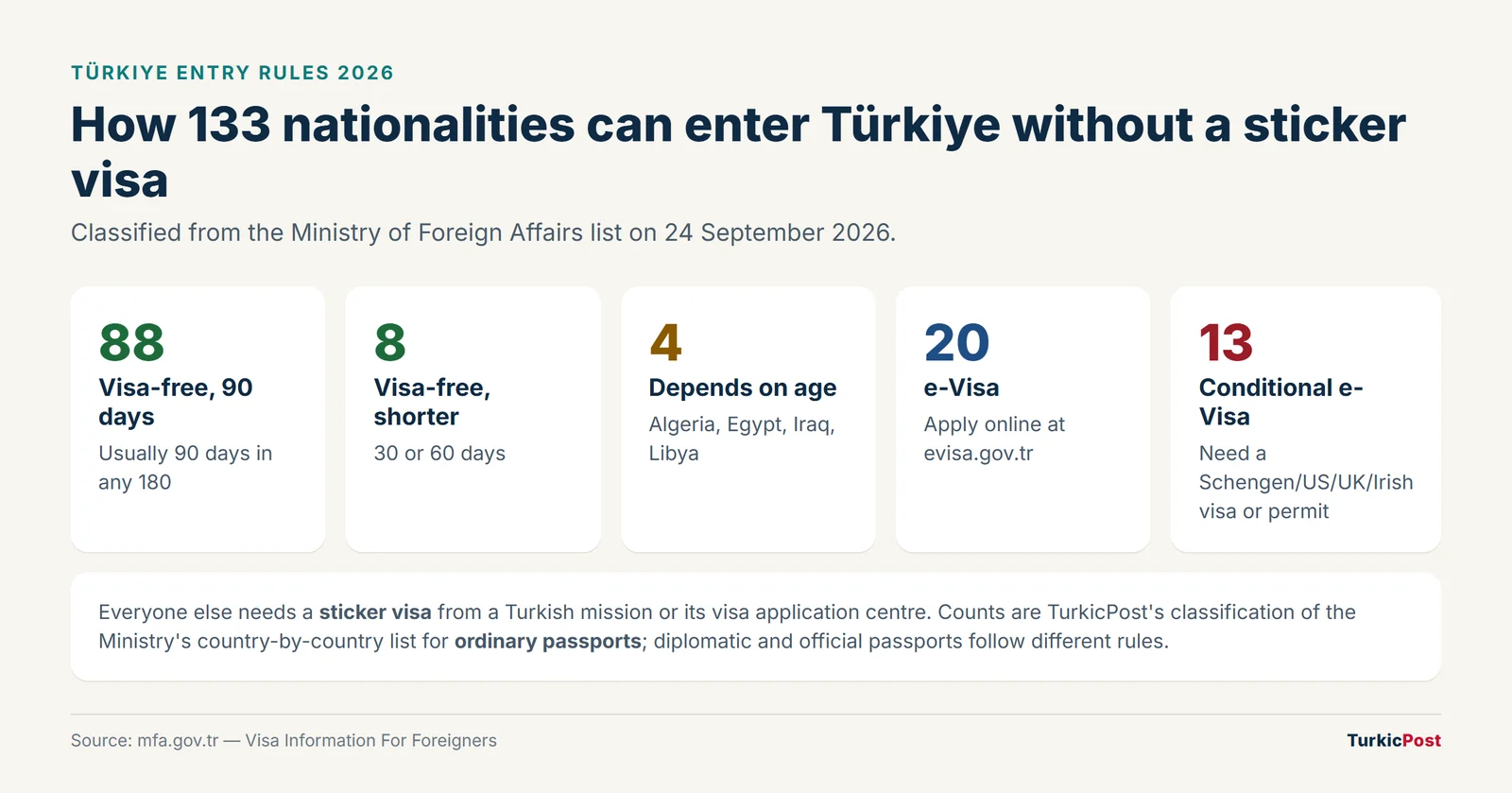
As of 24 September 2026, ordinary passport holders from 88 nationalities can enter Türkiye without a visa for up to 90 days, and 8 more can stay visa-free for 30 or 60 days. The 90-day group includes the United States, the United Kingdom, Canada, Australia, China, every EU country, the Gulf states, Japan, South Korea and four of the five other Turkic states. For four more countries (Algeria, Egypt, Iraq and Libya), the rule depends on your age. Visa-free entry covers tourism and business visits only. Your passport must also be valid for at least 60 days beyond your permitted stay.
Last checked: 24 September 2026, against the Ministry of Foreign Affairs’ country-by-country visa list. The rules below apply to ordinary passports. Diplomatic, official and service passports follow different rules.
Countries that can visit Türkiye visa-free for 90 days
These 88 nationalities can enter with an ordinary passport and stay up to 90 days, usually counted as 90 days in any 180-day period. We’ve grouped them by region so you can find yours quickly.
Europe (43): Albania, Andorra, Austria, Belgium, Bosnia and Herzegovina, Bulgaria, Croatia, Czech Republic, Denmark, Estonia, Finland, France, Germany, Greece, Hungary, Iceland, Ireland, Italy, Kosovo, Latvia, Liechtenstein, Lithuania, Luxembourg, Malta, Moldova, Monaco, Montenegro, Netherlands, North Macedonia, Norway, Poland, Portugal, Romania, San Marino, Serbia, Slovakia, Slovenia, Spain, Sweden, Switzerland, Ukraine, United Kingdom, Vatican City.
Caucasus and Central Asia (5): Azerbaijan, Georgia, Kazakhstan, Kyrgyzstan, Uzbekistan.
Middle East and North Africa (12): Bahrain, Iran, Israel, Jordan, Kuwait, Lebanon, Morocco, Oman, Qatar, Saudi Arabia, Tunisia, United Arab Emirates.
Americas (19): Argentina, Belize, Bolivia, Brazil, Canada, Chile, Colombia, Ecuador, El Salvador, Guatemala, Honduras, Nicaragua, Panama, Paraguay, Peru, Trinidad and Tobago, United States, Uruguay, Venezuela.
Asia, Pacific and Africa (9): Australia, China, Hong Kong (SAR passport), Japan, Malaysia, New Zealand, Seychelles, Singapore, South Korea.
A few of these come with conditions worth knowing:
- United Kingdom: the exemption is for ordinary passport holders travelling as tourists. Holders of British National (Overseas), British Subject and British Protected Person passports need a visa from a Turkish mission.
- United States, Canada and Australia: visa-free applies to ordinary passports only. Official passport holders from these countries need a visa.
- China: ordinary passport holders have been visa-exempt for up to 90 days in any 180 since 2 January 2026. Older guides still tell Chinese travellers to buy an e-Visa.
- Albania, Jordan, Kosovo, Lebanon, Qatar and Serbia: the Ministry words these as “90 days within six months starting from the first entry date”, for tourism and transit. That is a slightly different count from the rolling 180-day rule (see below).
- Hong Kong: the exemption applies to HKSAR passports. BN(O) passport holders need an e-Visa, and holders of the Hong Kong Document of Identity need a visa from a mission.
Countries with shorter visa-free stays
| Country | Visa-free stay |
|---|---|
| Russia | 60 days (tourism and business) |
| Belarus | 30 days per visit, no more than 90 days in a year |
| Brunei | 30 days |
| Costa Rica | 30 days |
| Indonesia | 30 days per entry, no more than 90 days in any 180 |
| Macao (SAR passport) | 30 days |
| Mongolia | 30 days (tourism) |
| Thailand | 30 days |
If you want to stay longer than these limits, the visa-free route won’t stretch. You need a visa from a Turkish mission before you travel, or a residence permit applied for inside Türkiye before your visa-free days run out.
Countries where your age decides
For four countries, the same passport gets different treatment depending on the holder’s age:
| Country | Rule for ordinary passports |
|---|---|
| Algeria | Visa-free for up to 90 days if under 15 or over 50. Conditional e-Visa for ages 15–18 and 35–50 |
| Iraq | Visa-free for up to 90 days if under 15 or over 50. Conditional e-Visa for ages 15–50 |
| Libya | Visa-free for up to 90 days if under 16 or over 45. Conditional e-Visa for ages 16–45 |
| Egypt | e-Visa with no extra condition if under 15 or over 45. Ages 15–45 need a Schengen, US, UK or Irish visa or residence permit and must fly with Turkish Airlines, AJet, Pegasus, EgyptAir or Air Cairo |
“Conditional e-Visa” means you need a valid Schengen, US, UK or Irish visa or residence permit to apply online. Families often get caught out here. A 52-year-old Iraqi parent can travel visa-free, but their 20-year-old child can’t.
Notice the gap in Algeria’s rule. Algerians aged 19 to 34 don’t qualify for the visa-free route or the conditional e-Visa, so they need a sticker visa from a mission.
How the 90-day limit is actually counted
“90 days in any 180” is a rolling window, not a counter that resets when you leave. On any day you’re in Türkiye, count back 180 days. The total days you spent in the country during that window can’t exceed 90.
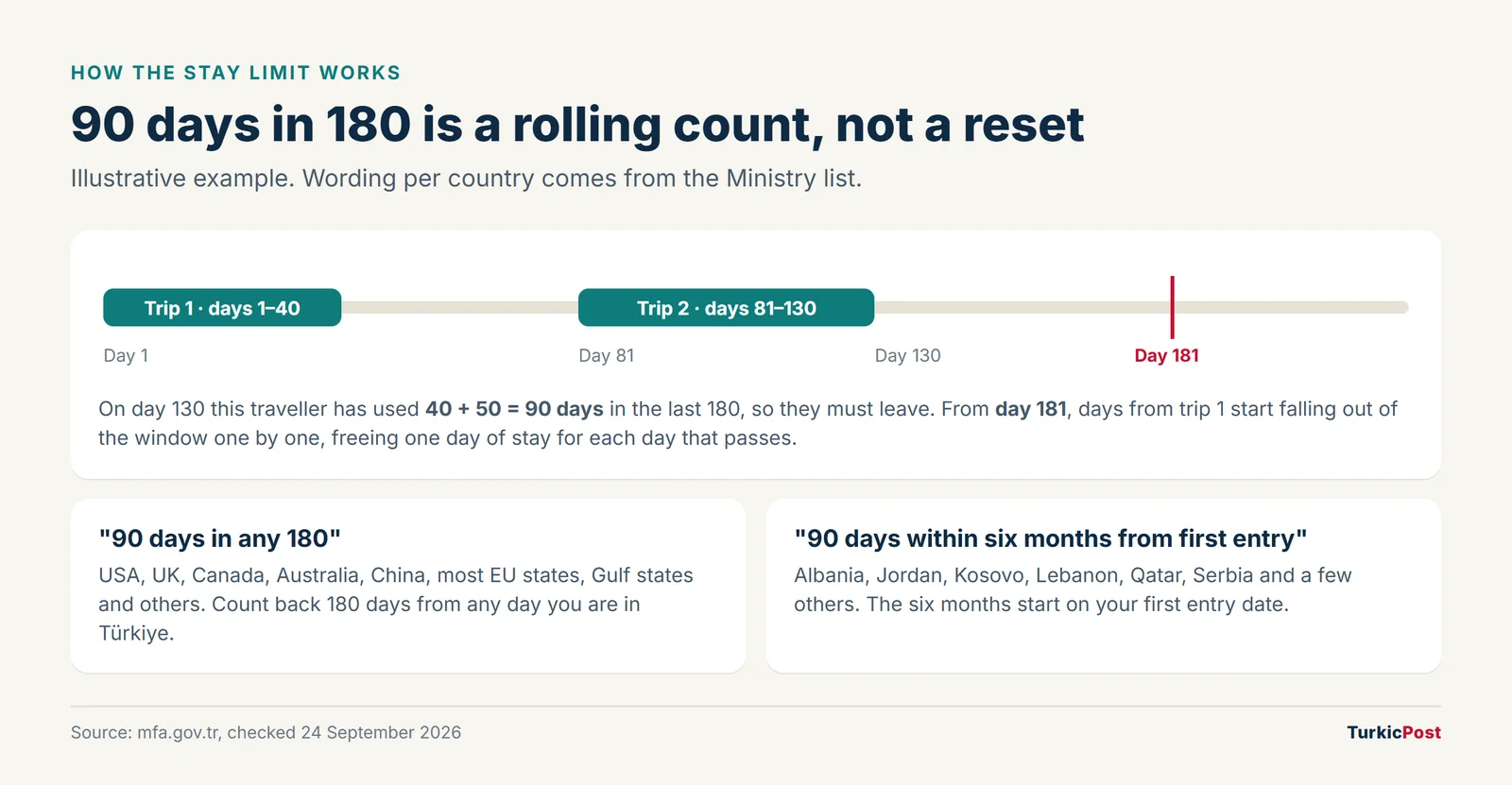
A practical example: you spend 40 days in Türkiye from 1 March, go home, and come back for 50 days in late May. After that second trip you’ve used all 90 days. You can’t re-enter visa-free until days from the March trip start dropping out of the 180-day window.
Overstaying is not a paperwork detail. The official e-Visa portal warns that overstayers may be fined, deported or banned from future travel to Türkiye for a set period.
What you still need at the border
Visa-free doesn’t mean nothing is checked. Carry these:
- A passport valid for at least 60 days beyond your stay. For a 90-day visit, that means at least 150 days of validity on arrival. This is the legal minimum under Article 7(1)(b) of Law No. 6458. The Ministry also advises six months, which is the safer target if your airline is strict.
- Or a national ID card, if your country qualifies. Citizens of Germany, Belgium, France, Georgia, the Netherlands, Spain, Switzerland and Italy can enter with a national ID card under a Council of Europe agreement. Bulgarian and Romanian ID card holders are also exempt for tourist trips. Ukrainians can use a biometric ID card on direct trips from Ukraine.
- Proof of your plans, such as a return ticket and accommodation. Border officers can refuse entry to any visitor.
Visa-free is for tourism and business, not work or study
The exemption covers holidays, visiting friends, transit and business meetings. It doesn’t cover taking a job or enrolling on a course. The Ministry says work and study visas are issued by Turkish embassies and consulates. Anyone planning to live, work or study in Türkiye must also register with the local authorities after arrival, whatever their visa status.
Not visa-free? Your other options
If your country isn’t listed above, you’re in one of three groups.
e-Visa countries (apply online at evisa.gov.tr):
| Country | What you can get online |
|---|---|
| Antigua and Barbuda, Bahamas, Barbados, Dominican Republic, Grenada, Jamaica, Maldives, Saint Lucia, Saint Vincent and the Grenadines, Hong Kong (BN(O) passport) | 3-month multiple-entry e-Visa |
| Mauritius | 1-month multiple-entry e-Visa |
| South Africa, Fiji | 1-month single-entry e-Visa |
| Mexico, Vietnam, Suriname, East Timor | 30-day single-entry e-Visa |
| Armenia, Namibia (since 5 May 2025), Greek Cypriot Administration | e-Visa |
Conditional e-Visa countries (you need a valid Schengen, US, UK or Irish visa or residence permit): Afghanistan, Bangladesh, Cape Verde, Equatorial Guinea, India, Nepal, Pakistan, Palestine, the Philippines, Senegal, Sri Lanka, Taiwan and Yemen. Some of these nationalities must also fly with specific airlines. The portal tells you when you select your country. We explain the process step by step for Indian citizens and Pakistani citizens.
Everyone else needs a sticker visa from a Turkish embassy, consulate or authorised visa centre, arranged before travel.
What each route costs, and how long it takes, is covered in our guide to Türkiye visa fees and processing times.
Can you still get a visa on arrival?
For a short list of nationalities, yes. The e-Visa portal lists visa on arrival for citizens of Antigua and Barbuda, Armenia, the Bahamas, Barbados, Bermuda, the Dominican Republic, Grenada, Hong Kong (BN(O)), Jamaica, the Maldives, Mauritius, Mexico, Saint Lucia, Saint Vincent and the Grenadines, and the Greek Cypriot Administration. The Ministry says e-Visas bought online cost less than visas bought at the airport. Buying online also means no queue on arrival.
Visa on arrival is not available to e-Visa nationalities such as India, Pakistan, Bangladesh, Egypt, Nepal, the Philippines or Vietnam.
The Turkic states: one exception
For TurkicPost readers travelling within the Turkic world, the picture is simple, with one exception. Ordinary passport holders from Azerbaijan, Kazakhstan, Kyrgyzstan and Uzbekistan are all visa-free for up to 90 days. Turkmenistan is the exception. Turkmen ordinary passport holders need a visa, and only official passport holders are exempt, for up to 30 days.
Where this list comes from
The table on this page is TurkicPost’s classification of the Ministry of Foreign Affairs’ Visa Information For Foreigners page, read in full on 24 September 2026. We counted every nationality whose ordinary passport holders can enter without a sticker visa.

Two things to know about official sources:
- The Ministry list is more current than the e-Visa portal’s FAQ. The FAQ still lists Australia, China, Croatia and the Baltic states as e-Visa countries, although the Ministry now shows them as visa-free. The same FAQ lists Dominica and Haiti as e-Visa-eligible, but the Ministry list doesn’t mention an e-Visa for them. If your country is one of these, check on evisa.gov.tr by selecting your nationality.
- Rules change without much notice. Turkish visa policy follows reciprocity, so a change in how your country treats Turkish citizens can change how Türkiye treats you. Check again close to your travel date.
Frequently asked questions
Do US citizens need a visa for Türkiye in 2026?
No, not with an ordinary passport. US citizens can stay up to 90 days in any 180-day period without a visa. US official passport holders do need one.
Do UK citizens need a visa for Türkiye?
No, for tourist trips. British citizens with an ordinary passport can stay up to 90 days in any 180. BN(O), British Subject and British Protected Person passport holders need a visa from a Turkish mission.
Is Türkiye visa-free for Indians or Pakistanis?
No. Both need either a conditional e-Visa, which requires a valid Schengen, US, UK or Irish visa or residence permit, or a sticker visa. Indian and Pakistani diplomatic passport holders are exempt.
Can I extend a visa-free stay in Türkiye?
Not by leaving and coming straight back once you’ve used your 90 days. To stay longer legally, apply for a residence permit at the Provincial Directorate of Migration Management before your permitted stay ends.