Card or Cash in Türkiye? Where Each Works in 2026
Card or cash in Türkiye in 2026? Where cards work, where you still need lira, why Istanbul transport is cheaper by İstanbulkart, and how to avoid DCC fees.


Card or cash in Türkiye in 2026? Where cards work, where you still need lira, why Istanbul transport is cheaper by İstanbulkart, and how to avoid DCC fees.
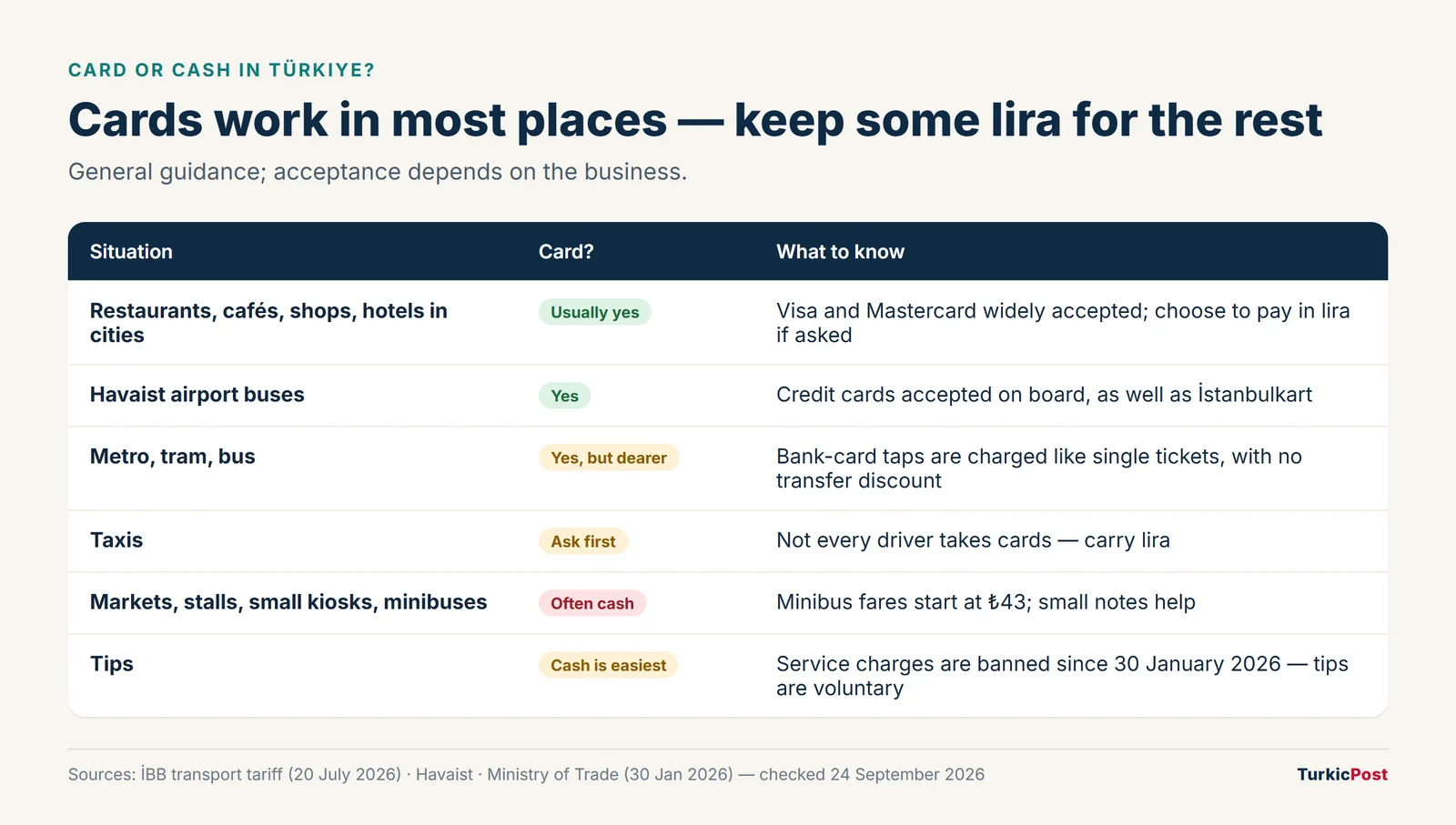
Use a card for most things in Türkiye’s cities, and carry some Turkish lira for the rest. Visa and Mastercard are widely accepted in restaurants, shops, hotels and on Havaist airport buses. You’ll still want cash for bazaar stalls, minibuses and shared taxis, small kiosks, some taxis and tips. Public transport is the big exception: you can tap a bank card on Istanbul’s metro, trams and buses, but the city charges bank cards the single-ticket price of ₺65 a ride. An İstanbulkart pays ₺46.20, with transfer discounts. Whatever you use, always choose to pay in Turkish lira, not your home currency.
Last checked: 24 September 2026, against İBB’s official transport tariff (20 July 2026), Havaist’s payment information and the Ministry of Trade’s January 2026 price rules.
Where cards work well
- Restaurants, cafés, bars and hotels in cities and resorts. Card machines are standard, and contactless payment is common.
- Supermarkets, chain stores and shopping centres.
- Havaist airport buses. Havaist says Visa, Mastercard, Maestro, American Express, Troy, Diners Club and Discover are accepted on board.
- Museums and major sights, and booking platforms for travel.
Visa and Mastercard are the safest choices. American Express is accepted less often. Troy is Türkiye’s domestic card scheme, so you’ll see its logo alongside the international ones.
Where you still need cash
- Bazaar and market stalls, street food and small kiosks.
- Minibuses and shared taxis (dolmuş). Minibus fares start at ₺43 for up to 4 km, and dolmuş routes have fixed fares such as Beşiktaş–Taksim for ₺55. You usually pay the driver in cash.
- Some taxis. Not every driver takes cards, so ask before you get in. Our Istanbul taxi prices guide explains the official meter rates.
- Tips. Since 30 January 2026, restaurants can’t add a service charge, so any tip is your choice. Cash is the simplest way to make sure it reaches the staff. See our guide to tipping in Türkiye.
- Smaller towns and villages, where card machines are less common.
The transport trap: bank cards cost more
Istanbul lets you pay on many transit lines by tapping a contactless bank card. The city’s tariff says those taps are charged like limited-use tickets:
| How you pay | One ride | A trip with one change |
|---|---|---|
| İstanbulkart | ₺46.20 | ₺46.20 + ₺34.40 = ₺80.60 |
| Contactless bank card | ₺65 | ₺65 + ₺65 = ₺130 |
Over a few days, the difference adds up to hundreds of lira. Buy an İstanbulkart as soon as you arrive. Our İstanbulkart guide shows where to buy one and how to top it up. Cash isn’t accepted on buses, trains or ferries at all. The tariff bans collecting cash fares.
Always choose lira, not your home currency
At a card machine or ATM you may be asked whether to pay in TRY or in your home currency. This is dynamic currency conversion (DCC). If you pick your home currency, the merchant’s provider sets the exchange rate, which is usually worse than your own bank’s.
- At card machines: choose TL / TRY.
- At ATMs: choose to be charged in lira, and decline the “guaranteed conversion” offer.
Getting cash: ATMs and exchange offices
- ATMs are everywhere in cities, and most have English menus. Check the fee screen before you confirm. The ATM owner may charge a fee, and your own bank may add another. Taking out fewer, larger amounts keeps fees down.
- Exchange offices (döviz bürosu) are authorised by the Ministry of Treasury and Finance. They display buying and selling rates and give you a receipt for every deal. What to look out for is in our guide to currency exchange in Türkiye.
How much cash to carry
There’s no official figure. What you need depends on your plans. A practical approach for a city break:
- Keep enough for a day of small purchases, minibuses and tips, in small notes.
- Top up from an ATM or exchange office when you run low, rather than carrying large amounts.
- Keep cards and cash in separate places.
If you arrive carrying more than €10,000 or equivalent in cash, declare it to customs. There’s no upper limit on how much you can bring in.

Check the price before you pay
Türkiye’s price-tag rules require restaurants and cafés to display their price lists where customers can see them, including at the entrance and on the tables. Since the Ministry of Trade’s change announced on 30 January 2026, the menu may show only the prices of the items themselves. Restaurants can’t add service, table or cover charges. If a bill includes one, you can ask for it to be removed, and report the business to the Ministry of Trade’s consumer line, 175.
Frequently asked questions
Can I use my Visa or Mastercard in Türkiye?
Yes. They’re widely accepted in city restaurants, shops, hotels and on Havaist airport buses. Keep some cash for markets, minibuses, some taxis and tips.
Is it better to pay in lira or my own currency?
Pay in lira. Choosing your home currency at a card machine or ATM triggers dynamic currency conversion, which usually uses a worse rate.
Can I pay for Istanbul transport by card?
You can tap a contactless bank card on many lines, but it’s charged at the single-ticket rate of ₺65 with no transfer discounts. An İstanbulkart costs ₺46.20 per ride.
Do I need cash in Istanbul?
Some. Cards cover most spending, but bazaar stalls, minibuses, dolmuş, some taxis and tips often need cash.